 Mayday Flowers
Peonies
A peony asks for very little: sun, a good hole and to be left alone. In return it flowers every June for longer than most of us will garden. Nearly every problem people have with peonies comes from one of a few simple mistakes, and this guide explains how to avoid them.
Herbaceous, tree and intersectional peonies
All garden peonies belong to the genus Paeonia, but they fall into three groups that grow and behave quite differently. Knowing which one you have tells you how deep to plant it, whether to cut it down in autumn and whether it can be divided.
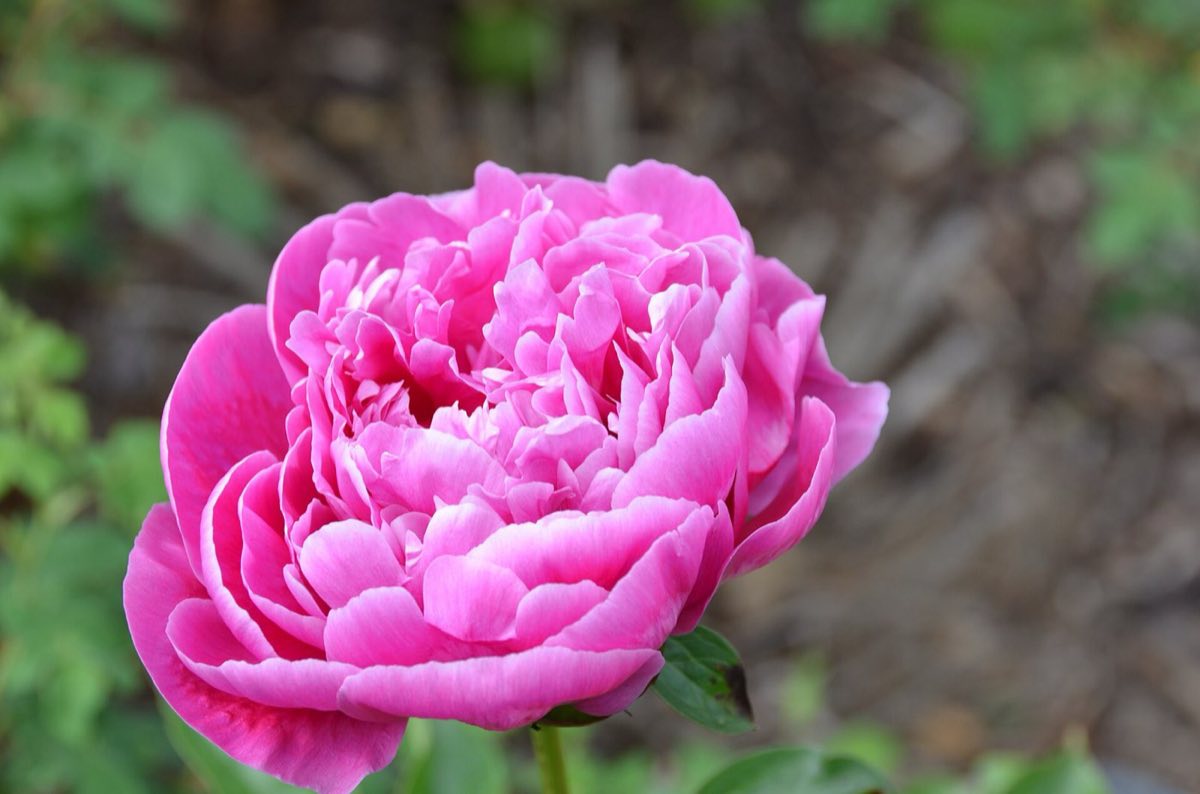
Herbaceous peonies Paeonia lactiflora, P. officinalis
Flowers: late May to late June. Height: 60 to 100 cm.
The familiar border peony. Red shoots push up in April, the plant flowers in early summer, and the leaves die down to the ground in autumn. Below ground is a crown of thick, fleshy roots with pink or red buds, called eyes, that will become next year's stems. Most garden varieties come from Paeonia lactiflora, which is often scented. The old European P. officinalis flowers two weeks earlier, usually in deep red or pink, and has no scent to speak of.
Tree peonies Paeonia suffruticosa and hybrids
Flowers: May. Height: 1 to 2 m.
Not trees at all but slow, woody shrubs that keep their stems through winter. The flowers are enormous, often 15 to 25 cm across, with silky, crumpled petals in white, pink, coral, purple and deep maroon. Hybrids with the wild yellow and red species add yellows and apricots. They are hardy, but the early buds can be caught by a late frost in May.
Intersectional peonies Paeonia Itoh hybrids
Flowers: June. Height: 75 to 90 cm.
Crosses between herbaceous and tree peonies, often called Itoh peonies. They grow like herbaceous plants, dying back almost to ground level, but have the leaf shape and flower size of tree peonies. Their stems are strong enough to need no staking, and side buds open after the main flowers, so the season lasts three or four weeks. They brought clear yellows into the border peony range.
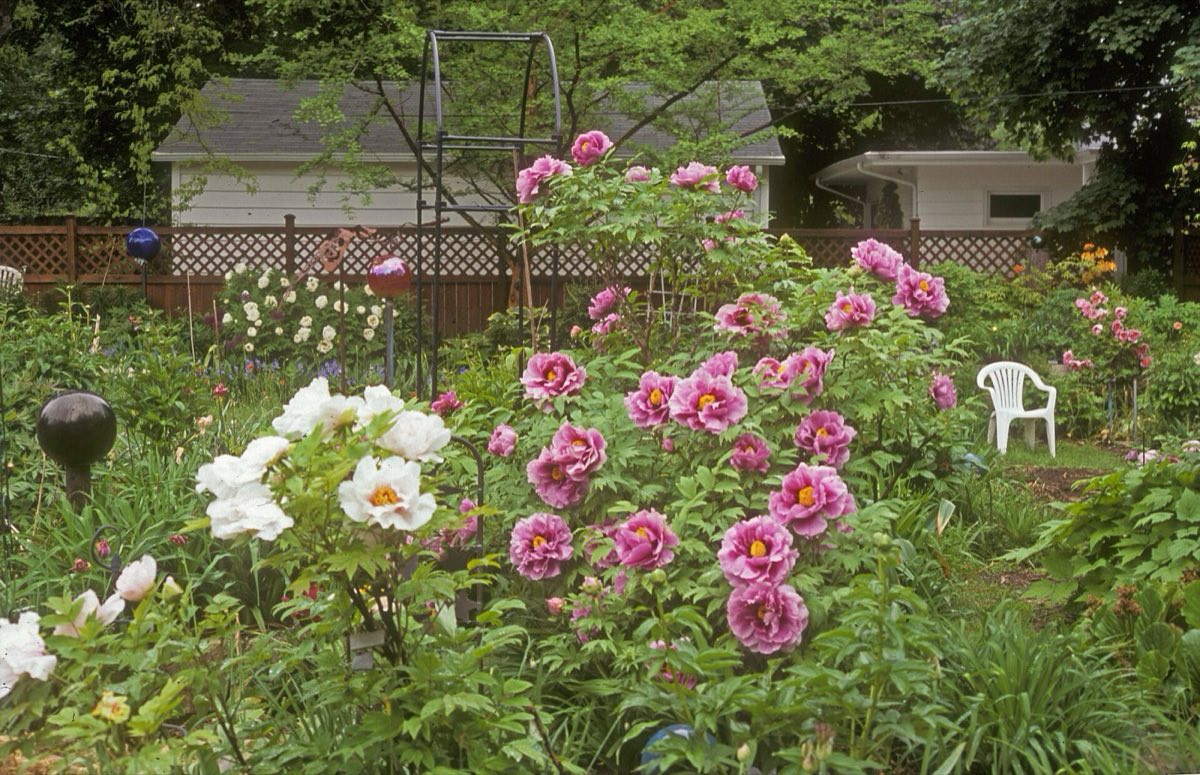
Tree peonies are usually sold grafted onto the root of a herbaceous peony. The graft is only a nurse: the plant is meant to grow its own roots from the woody stem and eventually shed the borrowed root. To make that happen, the graft union must be planted 10 to 15 cm below the soil surface. This is the one peony that should be planted deep.
A tree peony should never be cut to the ground. Its flowers come from buds on the woody stems, so pruning is limited to removing dead tips in spring, just above a fat, healthy bud.
Flower forms
Peony flowers are described by form, which depends on how many of the stamens have turned into petals or petal-like structures. The names appear in every catalogue and are worth learning, because form affects how a peony looks in the garden, how well it stands up to rain and whether bees can use it.
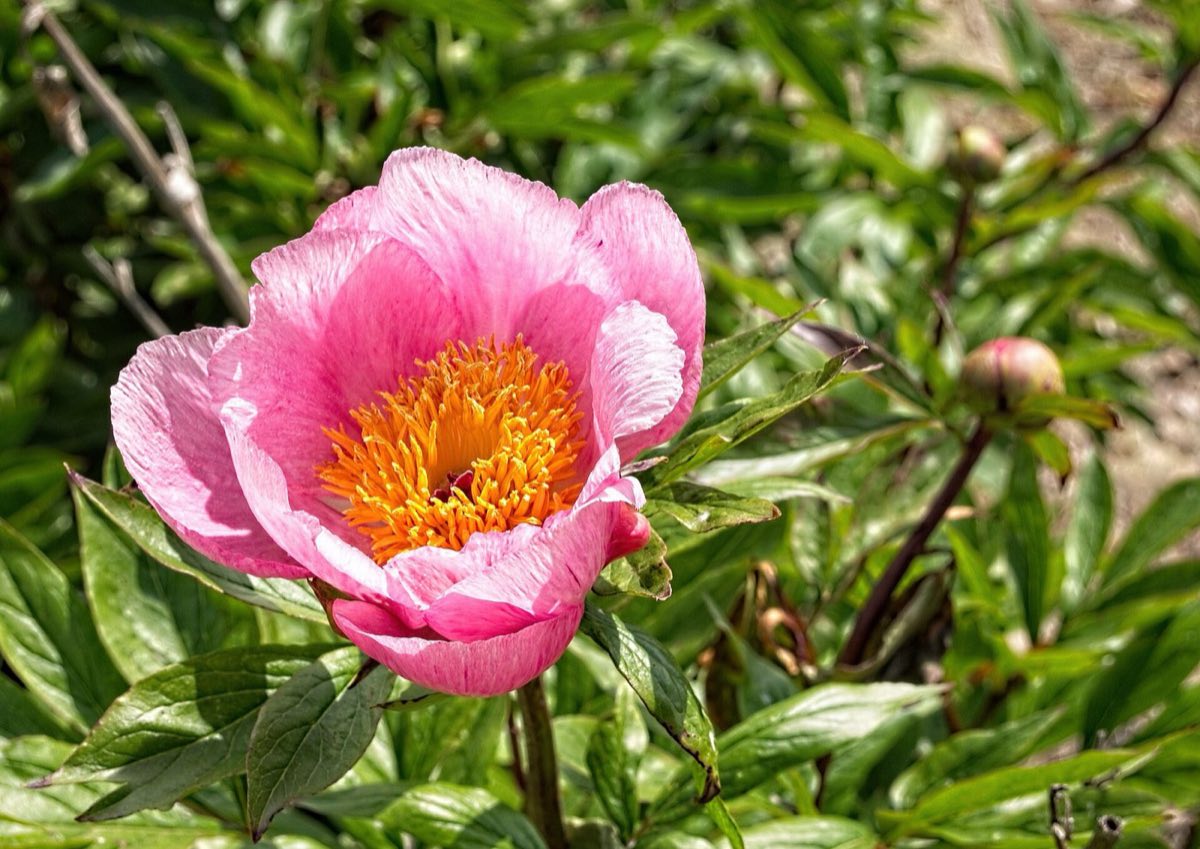
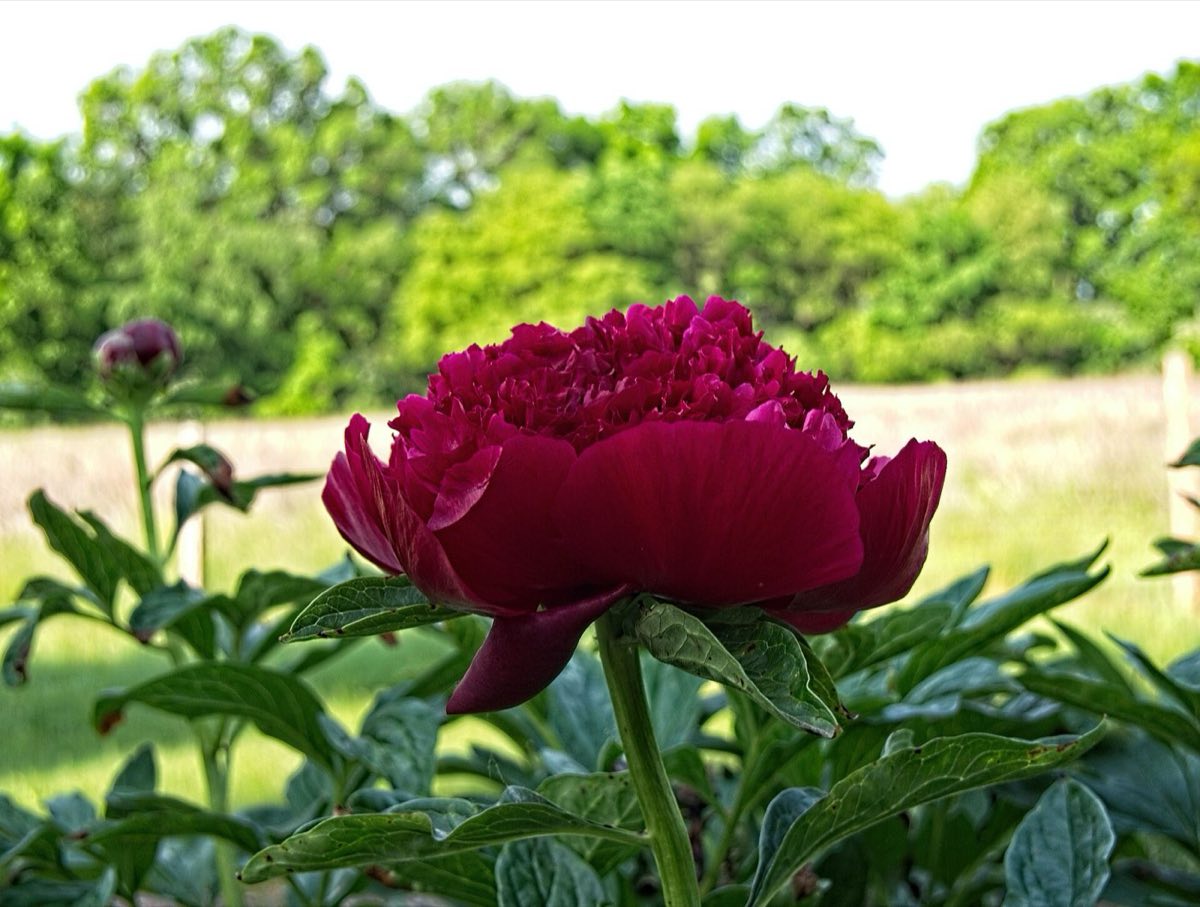
- Single: one or two rows of broad petals around a mass of pollen-bearing golden stamens. Light, elegant, rarely flops, and the best form for pollinators.
- Japanese: a single row of outer petals, called guard petals, around a centre of staminodes. These are stamens that have thickened and lost their pollen, often in yellow or a contrasting colour.
- Anemone: a step further. The central staminodes have become narrow, petal-like strips forming a raised, frilled cushion.
- Semi-double: several rows of petals with stamens still visible among them or in the centre. A good compromise between fullness and weather resistance.
- Bomb: guard petals with a dense, rounded ball of petals packed into the centre, like a scoop of ice cream on a saucer.
- Double: all the stamens have turned into petals, giving a full, heavy flower. The most romantic form, and the one most likely to collapse in rain.
In an exposed or wet garden, singles, Japanese and semi-doubles are far less trouble than the heavy doubles. In my own borders the doubles get supports and the singles get none.
Siting and soil
Choose the spot as if you will never move the plant again, because ideally you will not. Herbaceous peonies need at least six hours of direct sun to flower well. In part shade they produce healthy leaves and a few flowers, then fewer each year. Tree peonies are a little more tolerant and appreciate shade at midday, which also makes their flowers last longer.
Peonies need good air movement to keep botrytis at bay, so avoid tight corners and crowded borders. Allow about a metre between plants. Keep them well away from the roots of trees and large shrubs, which compete fiercely for water and food.
Soil
The ideal is deep, fertile, well-drained loam, neutral or slightly alkaline. Peonies cope well with clay as long as it does not waterlog in winter, because their fleshy roots rot in cold, wet ground. On heavy soil, plant on a slight mound. On light sandy soil, dig in plenty of well-rotted compost so the roots do not dry out in summer, when next year's buds are forming. There is more on improving soil on the soil and compost page.
Peonies do not need rich soil. Too much manure, especially fresh manure near the crown, gives lush leaves, fewer flowers and more disease.
Planting and planting depth
Bare root herbaceous peonies are planted from late August to early October, ideally at least four to six weeks before the ground freezes, so the roots can grow while the soil is still warm. In a garden where frost starts in late October, September is the month. Potted peonies can be planted in spring or early autumn.
A good division has three to five eyes and several thick roots about 15 cm long. Dig a hole about 50 cm wide and 40 to 50 cm deep, loosen the bottom and mix compost into the backfill. Refill the hole partly and firm it well, so the plant will not sink as the soil settles. Then set the root in place with the eyes pointing up.
Backfill around the roots, firming gently with your hands rather than your boot so the brittle eyes do not snap. Water thoroughly. If you plant from a pot, set the plant so the eyes end up at the right depth even if that means planting higher than the pot surface; nurseries sometimes pot peonies too deeply.
The first years
Gardeners have an old saying about peonies: the first year they sleep, the second they creep, the third they leap. A newly planted division spends its first season building roots. It may send up only two or three thin stems and perhaps one small flower, or none. This is normal.
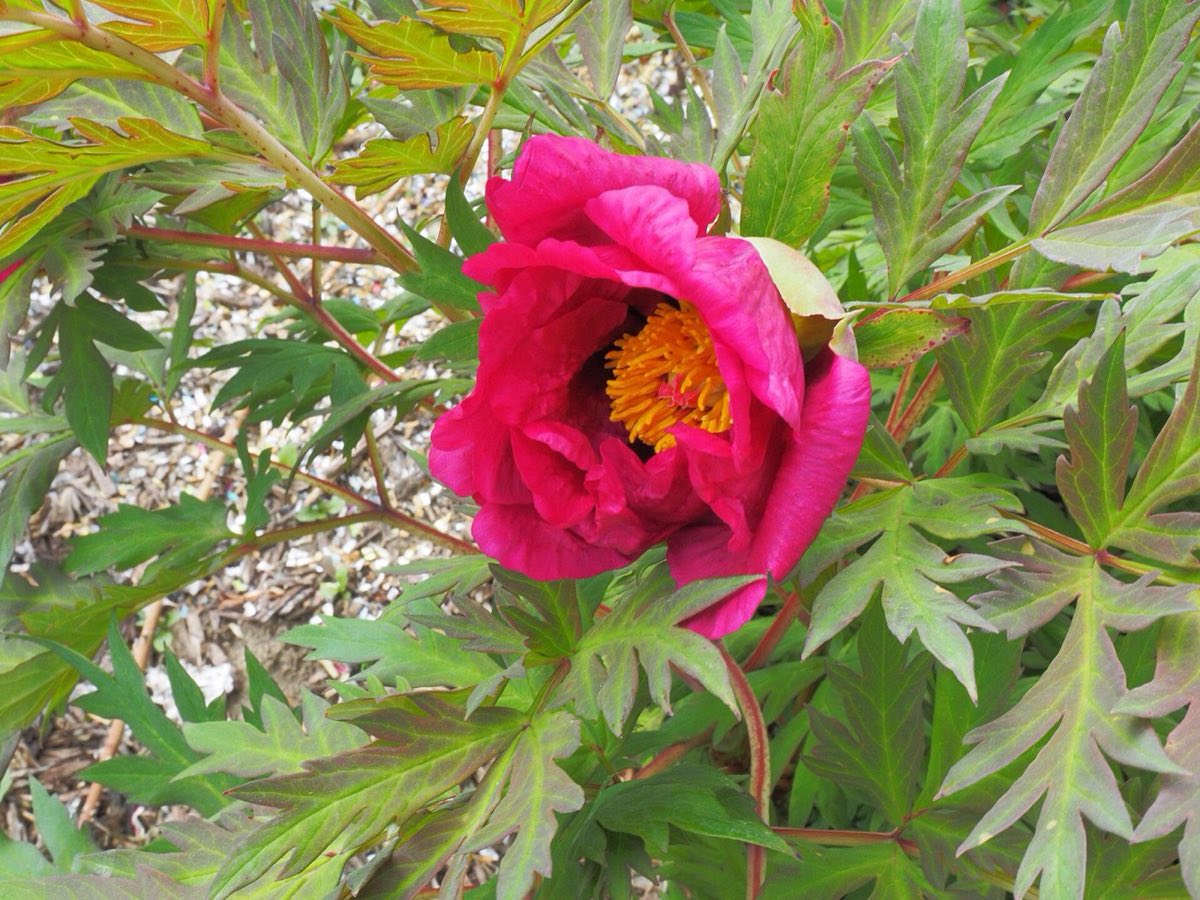
In the first spring, I pinch off any flower buds as soon as they appear, so the young plant puts its energy into roots. In the second year it usually makes more stems and a handful of flowers. By the third or fourth year a well-planted peony should be a full clump of a dozen stems or more.
During these years, keep the area weeded, especially of grasses that creep into the crown. Water deeply in dry spells, particularly in late summer when next year's eyes are forming. Do not move a young peony because it seems slow: every move sets it back to the beginning.
The foliage is the plant's food factory. Leave it standing until autumn, even after flowering, and resist cutting it down in August just because it looks tired.
Staking
A double peony in full flower holds a remarkable weight of petals. After a June downpour, each bloom can carry several times its own weight in water, and the stems bend to the ground. Singles, Japanese types and intersectional peonies usually stand up on their own; doubles and many bombs almost always need help.
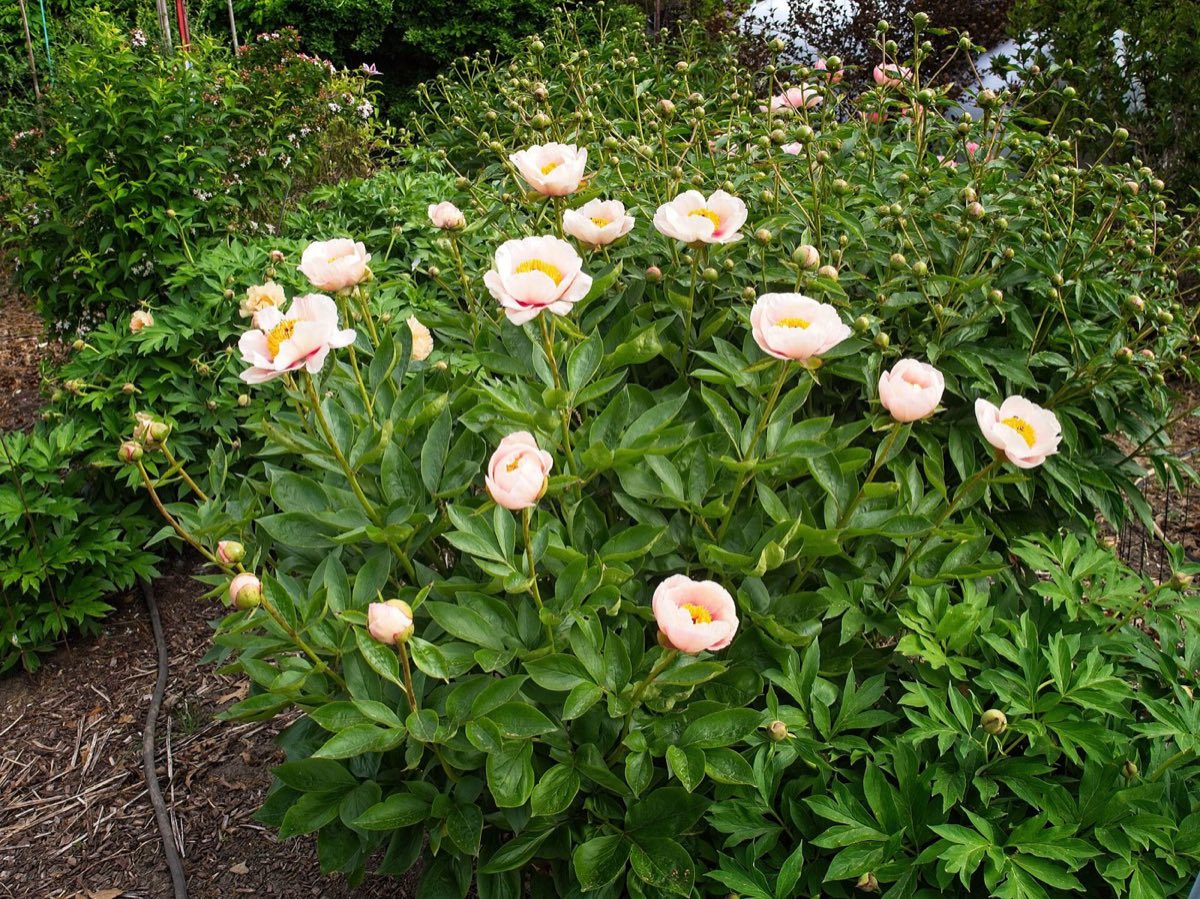
Put supports in early, when shoots are about 15 to 20 cm tall in late April or early May. Stems grow up through the support and hide it within weeks. Trying to gather a flopped peony later always breaks stems.
- Ring supports with a grid: the neatest option. Choose one about 60 cm high and wide enough for the whole clump.
- Three or four stakes and twine: push stakes in around the clump and run twine around them at two heights.
- Twiggy branches: push birch or hazel prunings in around the crown in spring. They look natural and are free.
Take care when pushing stakes in near the crown, as the roots spread wide and break easily. Keep stakes 15 to 20 cm out from the centre.
Cutting at soft bud
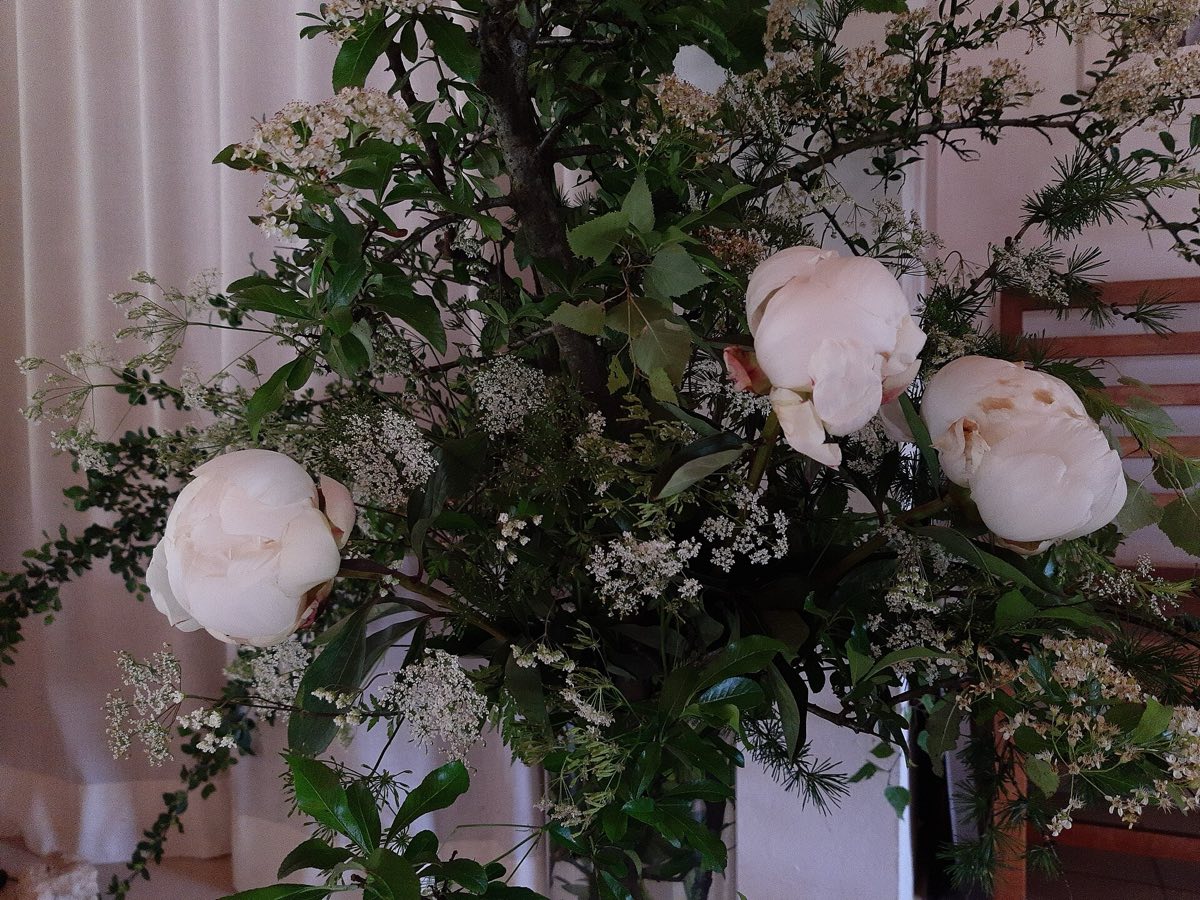
Peonies are superb cut flowers, and with a little care you can pick them in bud and open them days or weeks later. The key is cutting at the right stage, known as soft bud or the marshmallow stage.
Finding the right stage
Squeeze a bud gently between thumb and finger. A tight bud is hard as a marble and, if cut, will usually never open. A bud at soft bud stage shows true petal colour at the top and feels soft and springy, like a marshmallow. Singles and Japanese types are cut a little earlier, when the colour first shows; doubles are best cut slightly softer.
- Cut in the early morning, when stems are full of water.
- Leave at least two or three leaves on the stem below the cut, and never take more than a third of the stems from one plant. The leaves feed next year's flowers.
- Strip the lower leaves and put the stems straight into a bucket of cool water.
Storing in the fridge
Peonies at soft bud can be stored dry. Strip all the leaves, wrap small bunches in newspaper or a plastic bag, and lay them flat in the fridge at around 1 to 4 °C. Kept like this, they hold for two weeks and often longer. Keep them away from fruit, which gives off ethylene and spoils flowers.
When you want them, take them out, recut the stems by 2 to 3 cm and stand them in deep, tepid water. Most buds open within one or two days. A few may stay closed; these were cut too early. In the vase, peonies last five to seven days. There is more on growing flowers for picking on the cut flower garden page.
Dividing
Herbaceous peonies do not need regular division. An established clump flowers for decades without disturbance. Divide only to propagate a favourite, to rescue an old clump whose centre has died, or to move a peony that was planted in the wrong place.
The time is September, when the foliage is starting to yellow and next year's eyes are fully formed.
- Cut the stems down to the ground.
- Dig around the clump at a radius of about 30 cm and lever it out with a fork. Old clumps are heavy; work slowly and take as much root as you can.
- Hose off the soil so you can see the eyes and the shape of the crown.
- Leave the clump in the shade for a few hours. The roots soften a little and are less likely to snap.
- Cut the crown into pieces with a sharp knife or a clean spade. Each division should have three to five eyes and a few good roots. Smaller pieces survive but take years longer to flower.
- Trim off any rotten or damaged parts and replant at once, eyes 3 to 5 cm below the surface.
Divisions usually flower lightly in their second or third year. Intersectional peonies can be divided the same way but have very hard, woody crowns that may need a saw. Tree peonies are not divided at all. For other ways to multiply plants, see seeds and propagation.
Why peonies do not flower
A healthy-looking peony that never flowers is one of the most common garden puzzles. The answer is almost always in this table, and the first row is the usual culprit.
| Cause | How to tell | What to do |
|---|---|---|
| Planted too deep | Plenty of healthy leaves, no buds, for years. Eyes more than 5 cm down. | Lift in September and replant with eyes 3 to 5 cm below the surface. |
| Too young or recently moved | Planted or divided within the last two years. | Wait. Flowering improves from the third year. |
| Too much shade | Thin, leaning stems; flowering declining as nearby trees grow. | Move to full sun in September. |
| Division too small | Only one or two stems after several years. | Feed lightly, water in dry spells, and be patient. |
| Too much nitrogen | Lush, dark leaves and few buds; heavily manured or near a fed lawn. | Stop feeding. Mulch only with plain compost. |
| Foliage cut early last year | Leaves removed in July or August. | Leave foliage until autumn. |
| Late summer drought | Fewer stems or buds after a dry August. | Water deeply in dry spells from July to September. |
| Buds blasted | Small buds turn brown or black and stop growing. | Usually botrytis or a late frost. See the next section. |
| Root competition | Plant near a hedge or tree; soil dry and full of roots. | Move the peony to open ground. |
| Old, congested clump | Dead centre, flowers only around the edge. | Lift and divide, replanting the healthiest outer pieces. |
Botrytis
Peony grey mould, caused by the fungus Botrytis paeoniae, is the one disease every peony grower meets sooner or later. It is worst in cool, wet springs and in crowded, airless spots.
The first sign is often in May, when a few young shoots suddenly wilt and fall over. At the base, just at soil level, the stem is brown or black and soft. Later, small buds turn brown and shrivel without opening, and brown patches appear on leaves and open petals. In damp weather a grey, furry mould grows over the affected parts.
- Cut out wilted shoots as soon as you see them, right down to the crown or slightly below. Put them in the rubbish, not the compost.
- Pick off brown buds and spotted leaves through the season.
- In autumn, cut all stems to the ground and clear away every leaf. The fungus survives winter on old stems and debris.
- Do not pile wet mulch over the crown in spring, and do not overcrowd.
With good hygiene, botrytis is usually a nuisance rather than a disaster. A plant that has a bad year generally recovers fully. For more on fungal problems in general, see pests and diseases.
Ants on the buds
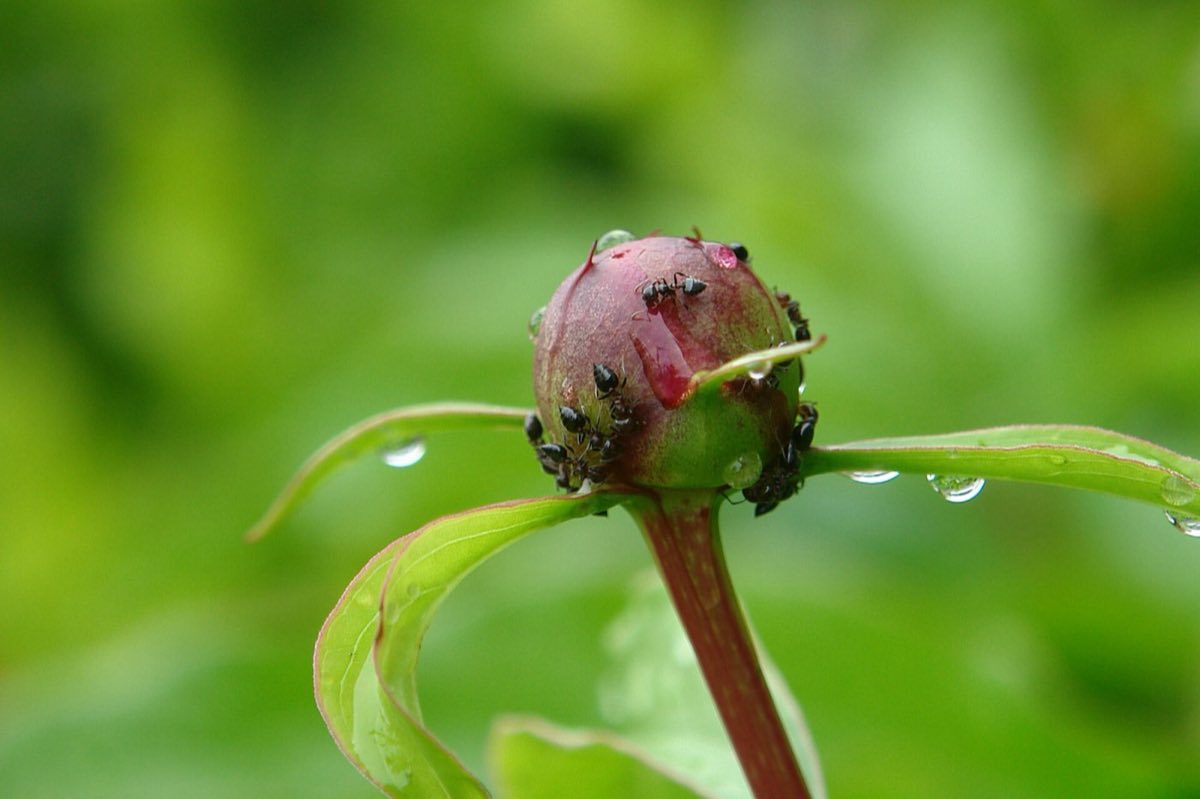
In May, peony buds often crawl with ants. It looks alarming, but they do no harm. The buds secrete a sugary nectar from the outer sepals, and the ants come to feed on it.
It is a common belief that peonies need ants to open their buds. They do not. Buds open perfectly well without them. Some believe the ants help by chasing off other insects, but either way there is nothing to do except leave them alone.
The only time they matter is when cutting flowers. Shake each stem gently outdoors, or dip the bud briefly in a bucket of water, before bringing it inside.
Autumn care
Peony leaves often turn to fine shades of bronze, red and purple in September before collapsing after the first frosts. Enjoy this, then tidy up.
- Herbaceous peonies: once frost has blackened the leaves, usually in October, cut every stem to ground level. Remove all the debris and burn or bin it if there was any botrytis.
- Intersectional peonies: cut the soft stems back to the short woody stubs at the base, about 5 to 10 cm high. Next year's buds sit on that wood, so do not cut below it.
- Tree peonies: do not cut back. Pick up fallen leaves. In very exposed gardens, wrap the shrub loosely in fleece or surround it with a wigwam of spruce branches to protect early buds from late frosts in spring.
Established herbaceous peonies need no winter protection; they actually need a cold winter to flower. A newly planted division benefits from a loose layer of spruce branches or straw over the crown after the ground has frozen, removed in early April.
Autumn is also the time for a light top dressing of compost around, not over, the crown, and for planting and dividing. Late summer jobs and the rest of the season are covered on the autumn page.
Companion planting
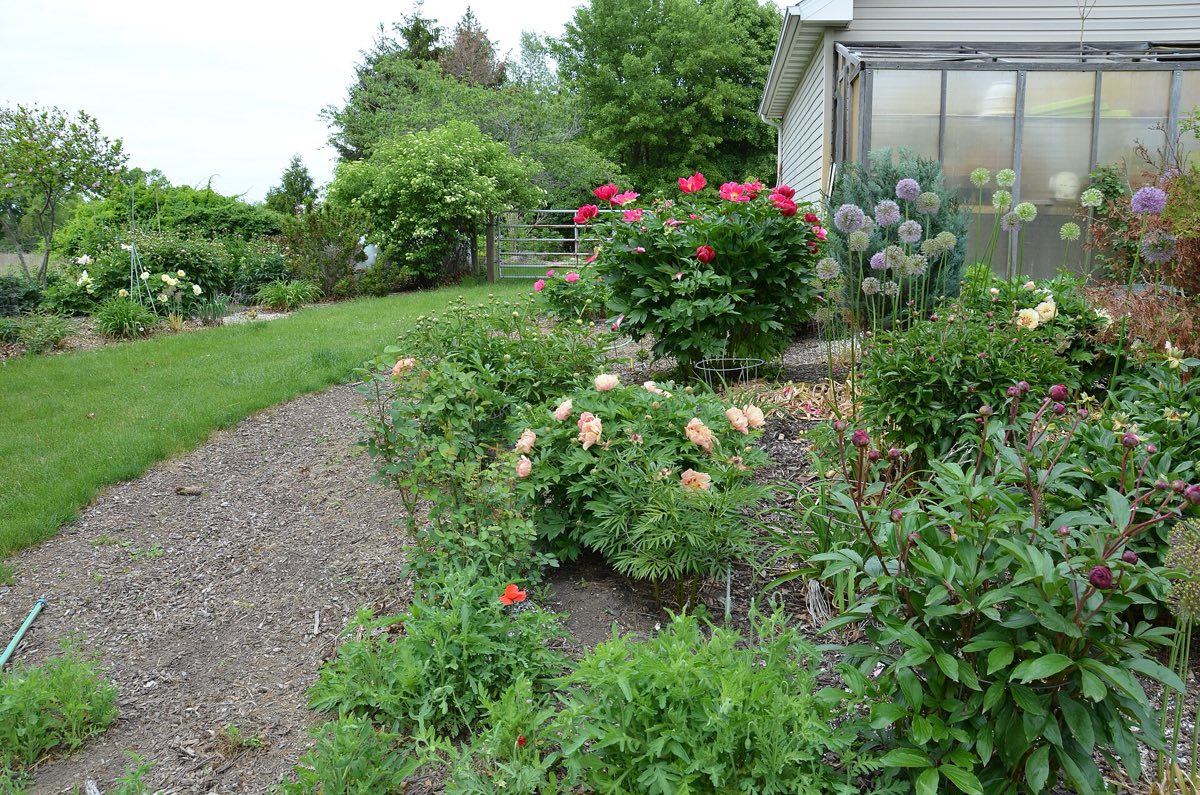
Peonies have a brief, glorious flowering, but their foliage stays handsome from April to October, so they make an excellent backbone for a mixed border. The trick is to choose companions that cover the gap before and after June without crowding the crown.
- Spring bulbs: tulips, daffodils and alliums planted 30 cm or more from the crown flower before or with the peonies, and the unfolding peony leaves hide their fading foliage. See bulbs.
- Bearded and Siberian irises: flower at the same time and provide upright, sword-shaped leaves as contrast.
- Catmint, hardy geraniums and lady's mantle: soft, low plants for the front that flower with the peonies and again later if cut back.
- Roses: peonies finish as the main rose flush begins, so a mixed planting of the two runs from late May to July. See roses.
- Late perennials: phlox, asters and sedums planted behind or between clumps carry the border into autumn.
Avoid vigorous spreading plants that will invade the crown, and keep a clear circle of about 30 cm around each peony.
Longevity
Few garden plants are as long-lived as the herbaceous peony. Clumps planted in one spot can flower for fifty years or more, and old peonies often survive in abandoned gardens long after the house has gone, still flowering every June among the long grass. Tree peonies, too, live for many decades and grow more impressive with age.
The deep red peony by the old fence was here when we came. Nobody knows who planted it. It has never been divided, fed only with what falls on it, and every year it opens on the same week.
The secret of that longevity is simple: a good position, the right depth and no disturbance. A peony that is planted well and then left alone becomes stronger every year. Its crown widens, the roots go deeper, and the plant becomes almost indifferent to drought and cold.
That is also why the initial planting deserves time. A peony is not a plant to try in one spot and move next autumn. Pick the sunniest open corner, prepare the hole properly, check the depth twice, and you are planting something that may outlast you. Seasonal reminders for peonies, from staking in May to planting in September, are on the garden calendar.