 Mayday Flowers
The Cut Flower Garden
A cutting patch is a working garden: rows of flowers grown to be picked, not admired from a distance. It asks for a little planning, a sunny strip of ground and a habit of cutting early in the morning. In return it fills the house with flowers from May until the first hard frost, and with dried stems through the winter.
Planning the patch
The first decision is where. Cut flowers want full sun for at least six hours a day, shelter from the strongest wind and soil that drains after rain. A strip along a vegetable plot is ideal, because it is usually open, already dug and out of the way of the ornamental borders, so you never feel guilty about stripping it bare. A patch in front of the house tends to stay uncut, because every stem you take leaves a visible hole.
How big
Smaller than you think. Two beds, each about 1.2 m wide and 4 m long, will give a generous bunch every week from midsummer to autumn for a household that likes flowers on the table. One bed is enough to learn on. The width matters more than the length: 1.2 m lets you reach the middle from either side without stepping on the soil, which keeps it loose and saves digging. If you only have room for one narrow border, make it 90 cm and work it from one side.
Beds and paths
Run the beds north to south if you can, so both sides get sun during the day and tall plants do not shade short ones for long. Put the tallest crops (sunflowers, cosmos, dahlias) at the north end or along the northern edge. Paths between beds should be at least 45 cm wide; 60 cm is kinder when you are carrying a bucket and a full armful of stems. Woodchip laid over cardboard is cheap, soft underfoot and rots down into something useful after two or three years.
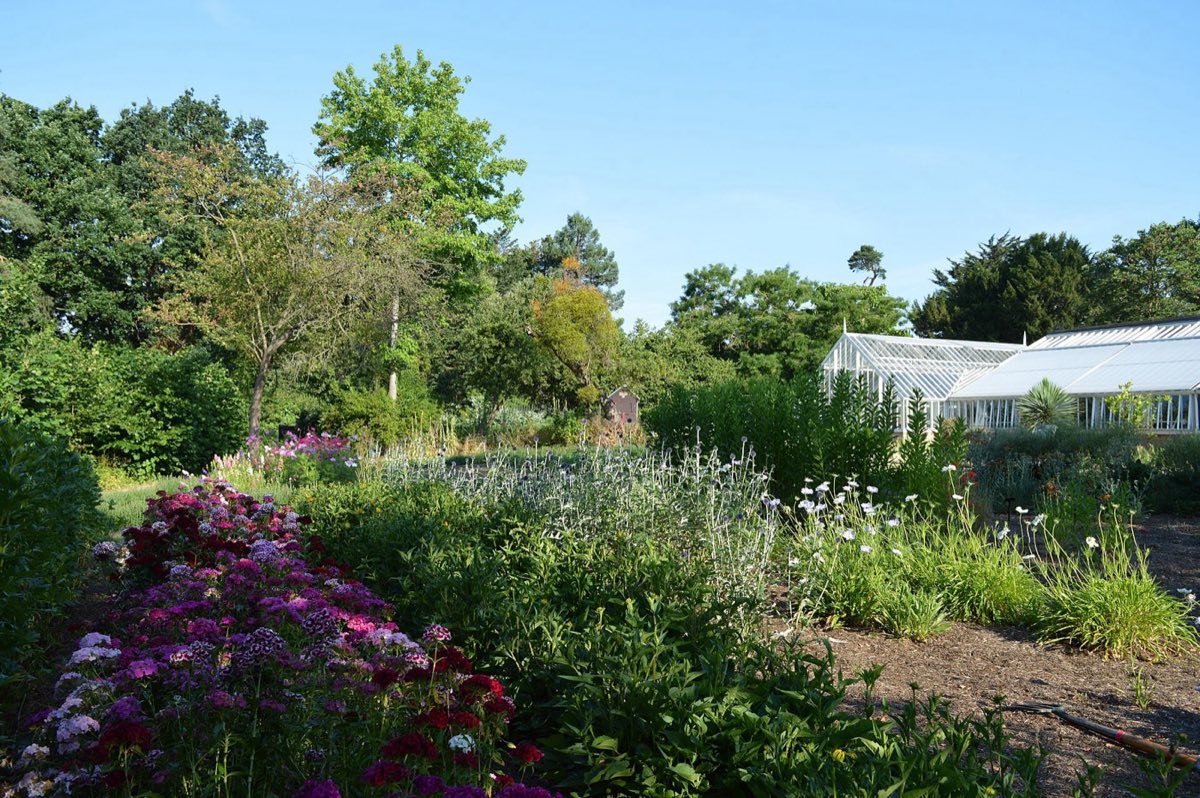
Plan in rows rather than drifts. A border designer mixes plants for effect, but a cutting patch is easier to manage when each crop has its own block or row. You can net a row of sweet peas, cut a row of zinnias hard and sow a fresh row of cornflowers without disturbing anything else. Rows also make it obvious when a crop is finished and the space is free.
Before sowing anything, clear perennial weeds thoroughly. Bindweed and couch grass in a cutting bed are a misery, because the flowers are planted densely and you cannot hoe between them once they grow. A season under black sheeting or cardboard and compost is worth the wait. See soil and compost for the no-dig method.
Succession
Succession is the difference between a glut in July and flowers for six months. It works in three ways. First, choose crops that peak at different times: tulips and narcissi in spring, sweet peas and cornflowers in early summer, zinnias and cosmos in high summer, dahlias and asters in autumn. Second, sow some fast annuals two or three times, three to four weeks apart, so a fresh row comes in as the first one tires. Third, sow hardy annuals in autumn as well as spring, which brings them into flower four to six weeks earlier the following year.
The best annuals for cutting
Annuals are the backbone of the cutting patch. They grow fast, flower within three months of sowing and are bred to keep producing as long as you keep picking. The phrase "cut and come again" describes them exactly: each cut stem triggers two side shoots, so a plant that is picked hard flowers more, not less.
Sweet pea Lathyrus odoratus
Flowers: June to August. Height: 1.5 to 2 m on supports.
The scent of a single bunch fills a room. Sow in deep pots in October or February, pinch out the tip at three pairs of leaves and plant out in April against netting or canes. Pick every two or three days without fail: once a plant sets pods, it slows down sharply. Old-fashioned grandiflora types have the strongest scent; the longer-stemmed exhibition types are better for arranging.
Zinnia Zinnia elegans
Flowers: July to first frost. Height: 60 to 100 cm.
Hates cold and root disturbance. Sow in modules in early May, plant out after the last frost, and pinch at 30 cm for branching. The stems are hollow just below the flower, so check a stem by wiggling it: if it bends, it is not ready. Dahlia-flowered and cactus-flowered forms last a week or more in water.
Cosmos Cosmos bipinnatus
Flowers: July to October. Height: 90 to 150 cm.
The most generous annual of all. Feathery foliage, white, pink or crimson saucers, and a habit of producing more the more you cut. Pick when the petals are just opening, not fully flat, for the longest vase life. Give it poor to average soil: rich ground produces leaves at the expense of flowers.
Cornflower Centaurea cyanus
Flowers: June to August. Height: 60 to 90 cm.
Hardy enough to sow in September for an early crop. The true blue is rare among cut flowers, and there are also near-black, pink and white forms. Cut when a third open. Dries well if hung upside down.
Sunflower Helianthus annuus
Flowers: July to September. Height: 1 to 2 m.
For cutting, grow the branching, pollen-free types, which give many medium flowers rather than one dinner plate and do not drop yellow dust on the table. Single-stem types are useful for succession: sow a short row every three weeks from May to early July.
Scabious Scabiosa atropurpurea
Flowers: July to October. Height: 70 to 90 cm.
Pincushion flowers in maroon, near-black, lilac and white on wiry stems. Bees love it. The seed heads, round and papery, are as useful as the flowers.
Other annuals worth a row: tall snapdragons (sow in February, store cut stems upright or the tips bend), China asters for late summer, annual phlox for small posies, calendula for an easy orange from June to frost, and statice for drying.
Perennials and shrubs for cutting
Annuals need sowing every year. Perennials and shrubs, once established, give stems with almost no work, and many of them flower at times when annuals are not yet ready. They do need a permanent spot, so give them a bed of their own at one end of the patch or plant them along the edge.
Perennials
- Peonies for June. A mature plant gives a dozen stems or more. Cut at the "marshmallow" stage, when the bud is soft when squeezed and shows colour. See peonies for planting depth, which matters more than anything else.
- Alstroemeria gives stems from June to September if pulled, not cut, from the base. Mulch the crowns well in autumn in a cold garden.
- Achillea in flat plates of terracotta, cream and dusky pink. Cut only when the flower head is fully open and the stem feels firm, or it will droop.
- Phlox paniculata for scent in late summer. Strip most of the leaves, which wilt before the flowers.
- Echinops and eryngium for steely blue, also good dried.
- Rudbeckia, helenium and Michaelmas daisies for late summer and autumn.
Bulbs belong here too. Tulips grown in a cutting bed are usually treated as annuals: plant in November 10 to 15 cm deep, cut with the whole stem, and replace next year. Narcissi, alliums and gladioli return reliably. Dahlias, technically tender perennials, are the queen of the autumn patch and deserve a bed of their own. More on spring bulbs in bulbs.
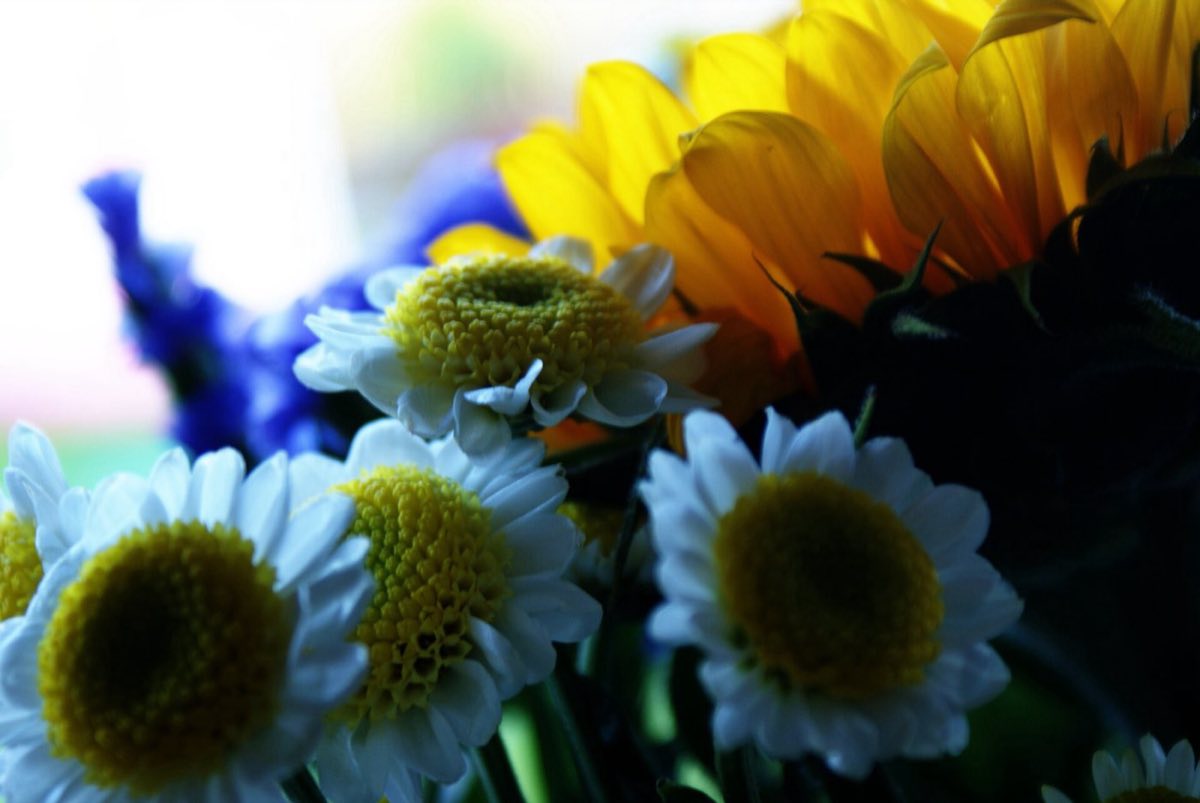
Shrubs
A few shrubs at the back of the cutting garden pay for their space many times over. Lilac and mock orange give scent in May and June, though both drink heavily and need their stems split upward 3 to 5 cm. Hydrangeas give heads from July that later dry on the plant. Roses, especially the repeat-flowering shrub types with a strong scent, give stems from June until October; cut in bud with colour showing. See roses.
Foliage and fillers
A bunch made only of focal flowers looks crowded and stiff. Most of the volume in a good arrangement is foliage and filler, and that is where a home cutting patch has its greatest advantage. Florists buy the same few greens; a gardener can pick anything that grows.
Foliage
Good foliage has a firm stem, lasts at least as long as the flowers and does not wilt within a day. Mint and lemon balm are excellent and smell clean. Eucalyptus grown as a cut-back shrub gives rounded silver leaves. Sage, rosemary and the grey-leaved artemisias add scent and colour. Ornamental grasses and oats give movement. Beech, hornbeam and young oak branches work well once the leaves have hardened in June; picked earlier, soft spring leaves collapse quickly. Perennial honesty and euphorbia are both useful, but euphorbia sap irritates skin, so wear gloves and sear the stem ends in hot water.
Fillers
Fillers are the airy, small-flowered plants that knit a bunch together.
- Ammi majus and Ammi visnaga, lacy white umbels like a refined cow parsley. Sow in autumn for the strongest plants.
- Orlaya grandiflora, a white umbellifer with large outer petals, low and prolific.
- Gypsophila and feverfew for clouds of tiny flowers.
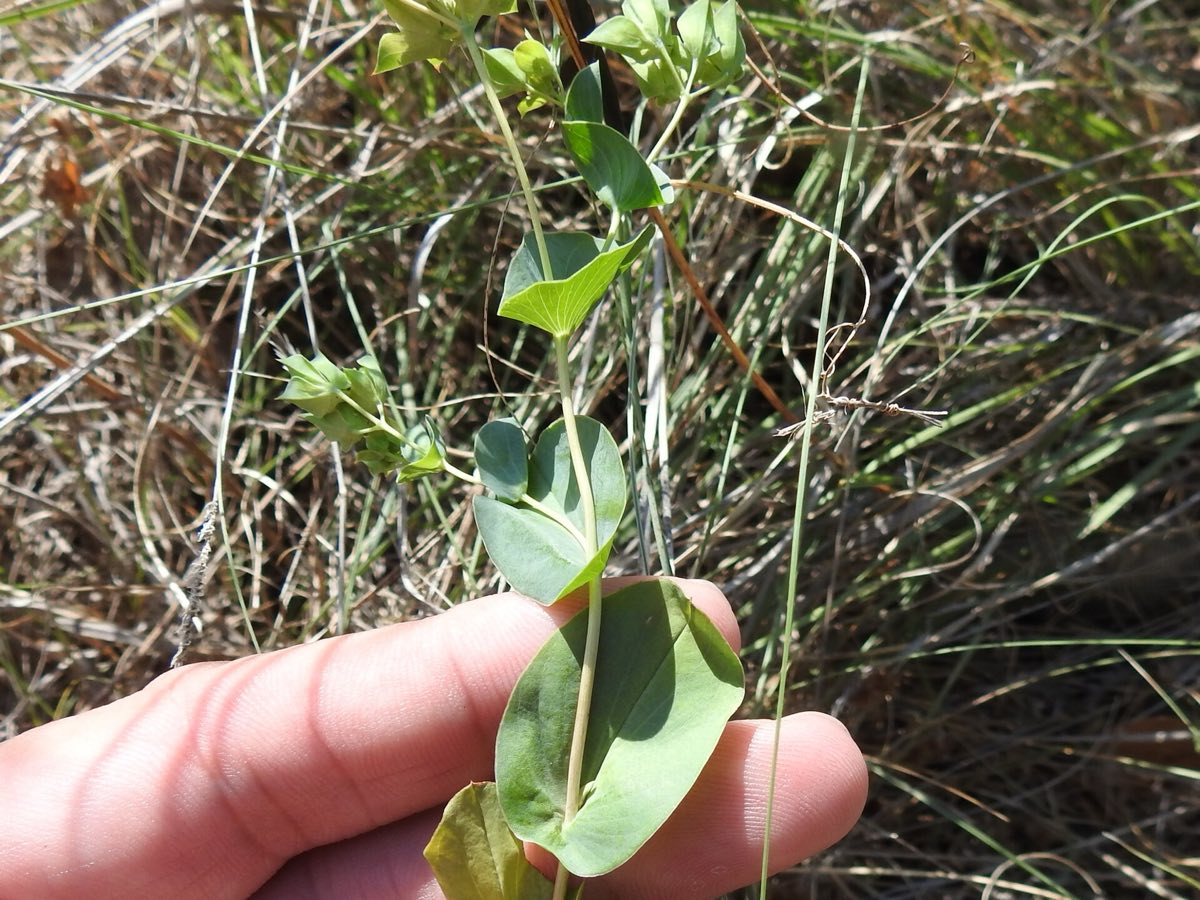
- Bupleurum, lime-green and long-lasting.
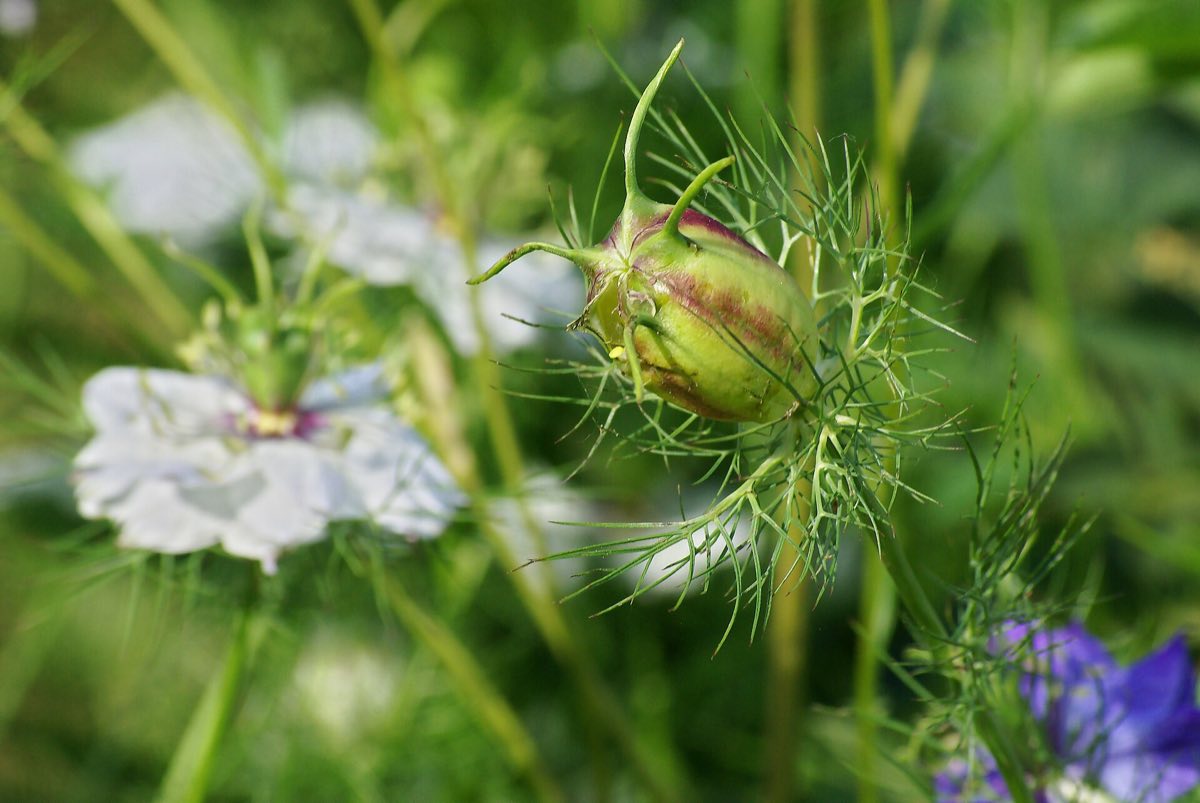
- Nigella, first as blue flowers, later as inflated seed pods.
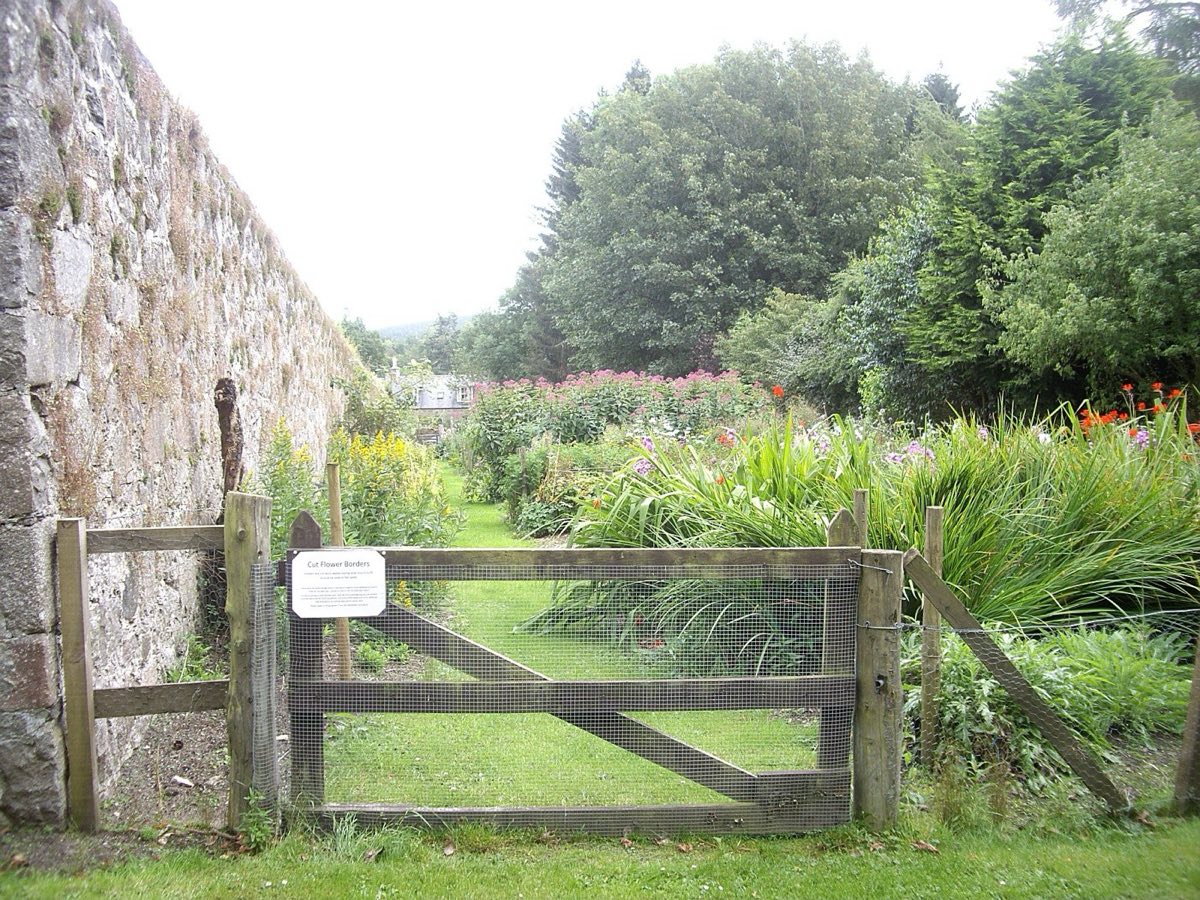
Sowing and spacing plan
Cut flowers are planted closer than border plants, because you want long straight stems reaching for light rather than bushy specimens. Closer spacing also shades out weeds. Do not go too far, though: crowded plants hold damp air and invite mildew. The table below is a plan that works in a garden with frosts until late April and the last risk of frost around mid May.
| Flower | When to sow | Where | Plant out | Spacing | First flowers |
|---|---|---|---|---|---|
| Sweet pea | October or February | Deep pots under cover | April | 15 to 20 cm along support | June |
| Cornflower | September or March to April | Direct or modules | October or April | 23 cm | May (autumn sown) or June |
| Ammi | September or March | Modules or direct | October or April | 30 cm | June |
| Snapdragon | February to March | Trays, light needed | Late April | 20 cm | June to July |
| Cosmos | April | Modules indoors | Mid to late May | 30 to 45 cm | July |
| Zinnia | Early to mid May | Modules indoors | Late May to June | 30 cm | July |
| Sunflower, branching | Late April to May | Modules or direct | Late May | 45 cm | July |
| Sunflower, single stem | May to early July, every 3 weeks | Direct | Not needed | 15 cm | About 70 days after sowing |
| China aster | April | Modules | Late May | 25 cm | August |
| Statice | March | Modules | May | 25 cm | July |
A few rules of thumb sit behind the table. Hardy annuals (cornflower, ammi, nigella, orlaya, larkspur) can be sown outdoors in autumn and will survive a cold winter as small rosettes, flowering weeks earlier and on stronger stems than spring sowings. Half-hardy annuals (zinnia, cosmos, cleome, China aster) are killed by frost and must wait until late May. Sowing them too early only produces leggy, starved plants that sulk after planting out. For sowing technique and module sizes see seeds and propagation.
Pinching
Pinching means removing the growing tip of a young plant, just above a pair of leaves, once it has three or four pairs. It delays flowering by about two weeks but produces a bushier plant with many more, longer stems. Pinch sweet peas, cosmos, zinnias, snapdragons, branching sunflowers and dahlias. Do not pinch single-stem sunflowers, stocks or anything grown for one large flower spike.
Supports and netting
A summer storm can flatten a cutting bed in a night, and stems that have been knocked over curve up again towards the light, which makes them useless for arranging. Support everything taller than about 60 cm, and put it in place at planting time or soon after. Supports added once the plants are tall rarely work and usually snap stems.
Horizontal netting
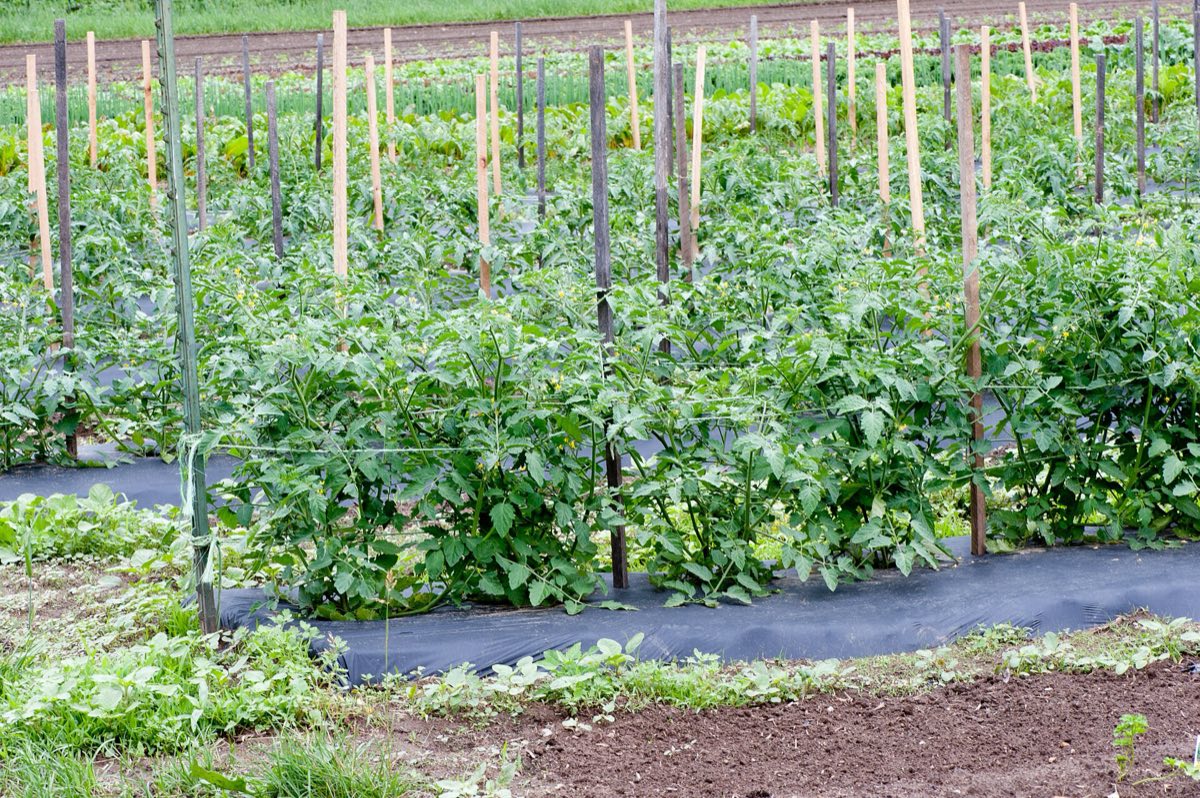
The most efficient method for a bed of annuals. Drive a stout post or cane into each corner of the bed and every 2 m along the sides. Stretch wide-mesh netting (squares of 15 to 20 cm) horizontally across the bed at about 40 cm above the soil, tying it firmly to each post. The plants grow up through it and are held as if in a grid. For very tall crops like cosmos and sunflowers, add a second layer about 40 cm above the first as they grow.
Other methods
- Corralling: posts at the corners of a bed with twine run around them at 30 cm and 60 cm. Quick and cheap, good for dahlias, achillea and phlox.
- Canes and string for single plants: one stout cane per dahlia, set at planting time so you do not spear the tuber later.
- Vertical netting or wigwams for climbers: sweet peas need something to grip, 1.8 to 2 m high. Many growers train cordons up single canes, removing tendrils and side shoots, which gives very long straight stems but takes time every week.
Harvesting technique and timing
When you cut matters as much as what you cut. Cut in the cool of early morning, when stems are full of water after the night, or in the evening once the heat has gone. Never cut in the middle of a hot day: stems lose water faster than they can take it up and the flowers wilt before you get them indoors.
Technique
- Take a clean bucket with 10 to 15 cm of cool water into the garden with you. Stems go straight in as you cut.
- Use sharp, clean snips or a knife. Blunt blades crush the water-carrying tissue at the stem end.
- Cut long. Go right down to a pair of leaves or a side shoot near the base of the plant. Short cuts produce short stems next time.
- Cut at an angle, which gives a larger surface to drink and stops the stem sitting flat on the bottom of the vase.
- Strip leaves that will sit below the water line while still in the garden, so they do not rot in the bucket.
- Leave the bucket in a cool, dark shed or room for a few hours before arranging.
The right stage of opening varies widely. Flowers cut too early may never open; flowers cut too late drop petals within days.
| Flower | Stage to cut | Vase life | Notes |
|---|---|---|---|
| Sweet pea | Bottom two flowers open, top in bud | 4 to 6 days | Pick every 2 to 3 days to stop pods forming |
| Zinnia | Fully open, stem firm below flower | 7 to 12 days | Use the wiggle test; no buds will open in water |
| Cosmos | Petals just opening, before flat | 5 to 7 days | Buds on the same stem will open |
| Cornflower | A third open | 6 to 8 days | Side buds continue to open |
| Snapdragon | Lower third of spike open | 7 to 10 days | Store upright to avoid bent tips |
| Sunflower | Petals lifting away from the centre | 7 to 10 days | Remove most leaves, which wilt first |
| Dahlia | Three quarters open; buds will not open | 4 to 6 days | Back petals should be firm, not papery |
| Peony | Soft bud showing colour | 5 to 8 days | Can be stored dry in a fridge for some weeks |
| Rose | Bud showing colour, sepals turned down | 4 to 7 days | Remove thorns below the water line |
| Ammi | About 80 percent of florets open | 7 to 10 days | Cut earlier and it droops |
Conditioning
Conditioning means giving cut flowers a long drink in a cool, dark place before arranging them. It sounds like fuss, but it is the single step that most improves vase life. A stem that has been allowed to fill with water for several hours, ideally overnight, stays turgid for days longer than one put straight into a warm room.
The basic method
Recut each stem under water or just before plunging it in, removing 2 to 3 cm. Stand the stems in deep, cool water up to about two thirds of their length. Leave them somewhere cool, dark and still: a shed, a cellar or a north-facing utility room. Darkness slows the flowers opening; coolness slows water loss.
Special treatments
- Woody stems (lilac, mock orange, viburnum, hydrangea): split the bottom 3 to 5 cm upward with secateurs and remove most leaves. Lilac in particular will collapse unless most of its foliage goes.
- Sappy stems (euphorbia, poppies): dip the cut end in boiling water for 10 to 20 seconds, protecting the flowers from steam with a paper bag. This seals the sap and stops the stem blocking.
- Narcissi: stand them alone in water overnight. They release a slimy sap that shortens the life of other flowers. Do not recut them after conditioning, or the sap flows again.
The summer I started conditioning everything overnight, my sweet peas went from lasting three days to lasting six. Nothing else changed.
Vase hygiene
Bacteria are the main reason cut flowers die early. They multiply in the water, feed on rotting leaves and sap, and block the stem ends so water cannot rise. The flowers then wilt even though the vase is full. Clean water and clean vessels prevent most of it.
- Wash vases and buckets with hot soapy water after every use, and scrub the inside. A thin brown film means bacteria are living there. A bottle brush makes this easy.
- Remove every leaf that would sit below the water line.
- Keep arrangements out of direct sun, away from radiators and the fruit bowl: ripening fruit gives off ethylene, which ages sweet peas and snapdragons fast.
- Change the water every two days, or every day in hot weather. Recut the stems by 1 to 2 cm each time.
Arranging
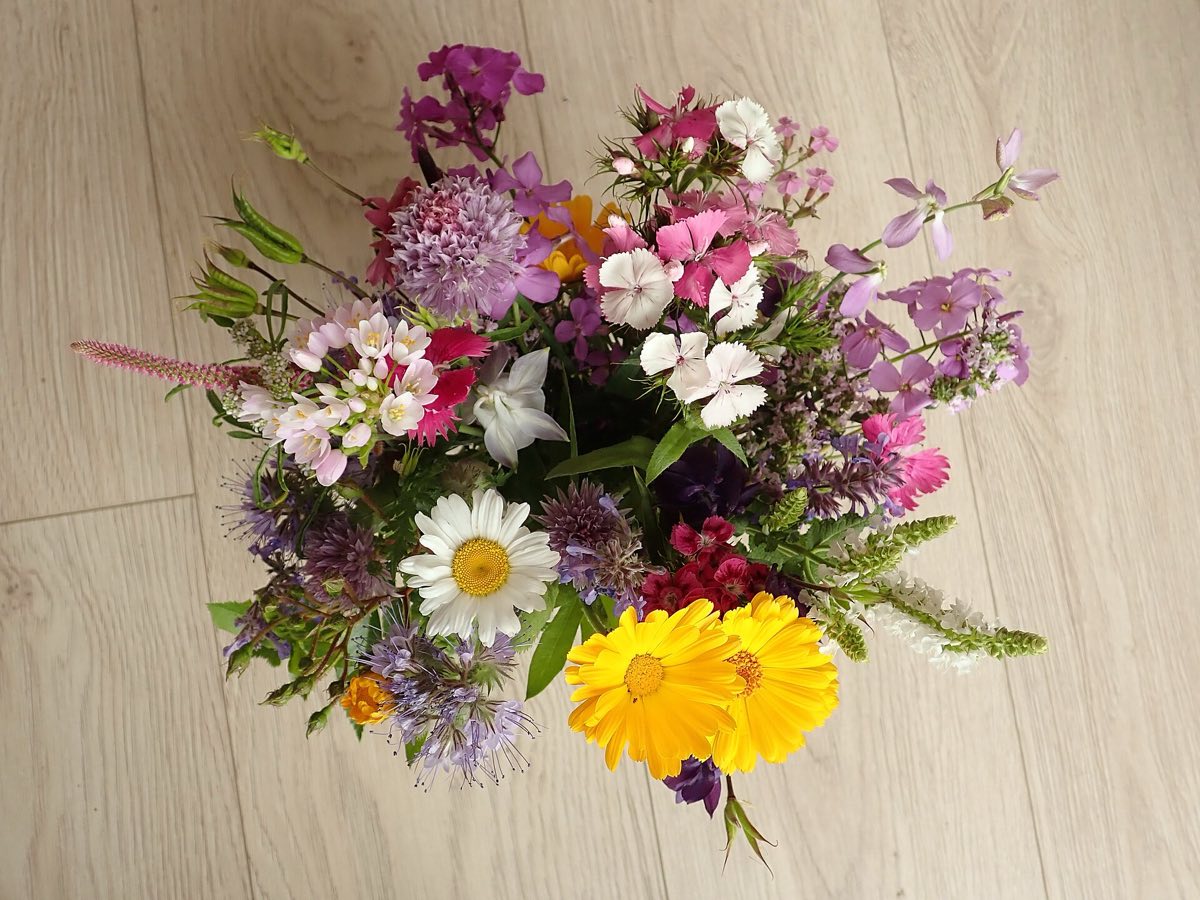
Arranging garden flowers is more forgiving than arranging bought ones, because garden stems curve and lean in ways that look natural. A simple structure helps. Think of four roles: focal flowers, fillers, foliage and something airy to finish.
The four roles
- Focal: the large, eye-catching blooms. Dahlias, peonies, roses, sunflowers, large zinnias. Use an odd number, usually three or five, and place them at slightly different heights rather than in a flat row.
- Filler: medium flowers and sprays that give body. Cosmos, scabious, cornflowers, phlox, achillea, sweet peas.
- Foliage: the base and frame. Mint, eucalyptus, beech, raspberry leaves, pittosporum.
- Airy: the finishing touch that breaks the outline. Ammi, grasses, nigella, gypsophila, a single long-stemmed cosmos leaning out.
A simple order of work
- Choose the vessel first. A jug or vase with a narrow neck holds stems in place with no mechanics.
- Build a frame of foliage, crossing the stems inside the vessel so they support each other.
- Add the focal flowers, spacing them through the frame.
- Fill the gaps with the filler flowers, working all the way round.
- Finish with the airy stems, letting a few rise above and fall over the edge.
Colour
Two easy approaches suit cut garden flowers. Tonal bunches use one colour family in different shades: plum, burgundy, dusty pink and cream, for instance. Contrast bunches put complementary colours together, such as orange and blue, or purple and lime green. Green fillers and white flowers calm almost any combination.
Drying and everlasting flowers
From late summer, set aside some stems for drying. A bunch of dried flowers on a winter windowsill is a reminder of July and costs nothing. Some plants, called everlastings, have papery petals that hold their colour and shape almost unchanged when dried.
Plants for drying
- Strawflower (Xerochrysum bracteatum): cut when the outer petals have opened but the centre is still tight. If cut fully open, the flower keeps opening as it dries and the centre goes fluffy.
- Statice (Limonium sinuatum): cut when most of the papery calyxes show colour.
- Honesty (Lunaria annua): leave the pods on the plant until brown, then rub off the outer skins to reveal the silver discs.
- Nigella, poppy and scabious seed heads, cut once the pods have firmed.
- Lavender, achillea, sea holly, echinops and larkspur all hold colour well.
How to dry
Cut on a dry day after the dew has gone. Strip the leaves, which hold moisture and shrivel unattractively. Gather stems into small bunches of five to ten and secure them with a rubber band rather than string, because stems shrink as they dry and string lets them fall. Hang them upside down in a dark, dry, airy place: an attic, a spare room or a dry shed. Light fades colour quickly. Most flowers are dry in two to three weeks; they are ready when the stems snap rather than bend.
A year of bouquets
A well-planned patch, backed by a few shrubs and bulbs, can give something to cut in almost every month. In a garden with frost from late October to April, the year runs roughly like this.
February and March
Branches forced indoors: forsythia, flowering currant, pussy willow and cherry, cut on a mild day and stood in warm water in a light room, will open in one to three weeks. Hellebores floated in a shallow bowl. The first snowdrops in a tiny glass.
April and May
Narcissi and tulips, then forget-me-nots, wallflowers and the first lilac. Autumn-sown cornflowers and ammi start in late May in a mild year. This is the season of fragrance: lily of the valley, hyacinths, and the first sweet peas from an October sowing.
June
Peonies, roses, sweet peas, alliums, early achillea and lupins. Probably the most lavish month, and the time to keep picking hard so that annuals keep producing.
July and August
Everything at once: cosmos, zinnias, snapdragons, sunflowers, scabious, phlox, gladioli, the first dahlias. A bunch a day is possible from a modest patch. Start cutting for drying.
September and October
Dahlias at their peak, China asters, Michaelmas daisies, late cosmos and rudbeckia. Rose hips, crab apples and turning leaves give autumn arrangements their warmth. When the first frost is forecast, cut everything worth having the evening before; a frosted dahlia is black by lunchtime.
November to January
Dried flowers, seed heads and evergreen branches. Holly, ivy, conifer sprigs and the coloured stems of dogwood and willow make winter jugs. This is also the time to plan: look back at the notebook, decide what to grow more of, order seed and sow the first sweet peas indoors in February. See winter and the calendar for the month-by-month jobs.